
Floor Mats Do Reduce Impact Severity: They Work!
Colleagues,
Protecting patients from injury when they fall requires different interventions than preventing them from a fall. The main intervention to reduce impact when patients fall from bed is a floor mat placed at bedside when the patient is in bed.
We know that physical trauma from blunt force trauma results in a serious injury to the body. One source of physical trauma due to blunt force is when the body falls onto the floor. Such impact causes hematomas, lacerations, concussions and/or fractures. The burden of trauma requires that interventions are implemented to protect patients by reducing the risk of such physical trauma when they fall. Over 10 years ago, Oliver et al.,(2010) recommended that we reduce injury when a patient falls. We cannot prevent all falls, but we can protect our patients from injury. We also know that when patients fall onto padded flooring, such as carpet or high impact absorbing flooring, the force of impact is reduced. The force of trauma sustained is very different than falling the same way onto concrete or tile flooring.
However, hospitals, long term care facilities, and assisted living facilities are not going to invest in high impact absorbent flooring, as it is too expensive. Still, evidence exists that impact absorbing flooring is effective. Gustavsson, et. al., (2015) investigated the fall-injury reducing effect of impact absorbing flooring among female nursing home residents when they fell on regular flooring compared to 12mm thick composite absorbing tile flooring. Briefly, 254 residents fell onto regular flooring and 77 falls on impact flooring. “The injury fall rate was 30.3% for falls on regular flooring and 16.9% for falls that occurred onto impact absorbing flooring. … The impact flooring significantly reduced the relative risk of injury by 59% (RR 0.41 (95% CI 0.20 to 0.80)) (Gustavsson, et al., p. 320). Colleagues, the impact absorbing flooring is protective — so are floor mats.
While we hope and wait for hospitals to replace flooring with impact absorbing flooring, our next best intervention is a floor mat placed at the bedside. Floor mats placed on the floor at the bed or chair side have been implemented in many veterans’ administration medical centers and LTC settings since 2004 (National Center for Patient Safety [NCPS], 2014). The floor mats have been shown to reduce the risk of severe head injury from approximately 40% for falls occurring at the normal bed height over the rail onto unprotected flooring to approximately 1% for falls from a low bed position onto a floor mat (Bowers et al., 2008), as measured by head injury criteria. For years, floor mats have been included in national toolkits and resources, including the Institute for Healthcare Improvement (Boushon et al., 2012) and national guidelines for hospital fall prevention programs (NCPS, 2014; Ganz, et al., 2013; Pearson, et al., 2011).
If floor mats are available in an organization, floor mat use is dependent on nursing staff. The leading barrier to floor mat use is their concern about trip hazards. So, it is our responsibility together to reduce these barriers, so that the severity of injury is reduced when patients fall from a bed or chair, benefiting patients by reducing harm (Quigley, 2015). To promote the nursing staff or anyone from tripping when walking onto a floor mat, all floor mats should have a beveled edge. All staff should be instructed to exercise caution when walking onto a floor mat. To help you further, colleagues, I am referring you to resources still available on the Department of Veterans Affairs (VA) National Patient Safety Falls Toolkit – the Floor Mat Implementation Guide and Fall Mat Examples.
Floor Mat Implementation Guide.
Since 2014, a Floor Mat Implementation Guide has provided helpful tips and best practices to support staff adoption and safe use of bedside mats.
The guide offers valuable insights, such as placing the mat on the safe exit side of the bed and reminding staff to use caution when stepping onto it. It also outlines patient selection criteria, since not every patient should have a floor mat. Floor mats are recommended for patients who may get up without assistance, can move independently in bed, attempt unassisted transfers, and are at greater risk of injury — for example, those who are anticoagulated, osteoporotic, at fracture risk, or have a history of fractures.
However, it was written nearly a decade before the introduction of the Performance Mat. Because the Performance Mat is designed to remain at the bedside at all times, some of the guide’s recommendations no longer apply, depending on the type of mat your facility uses.
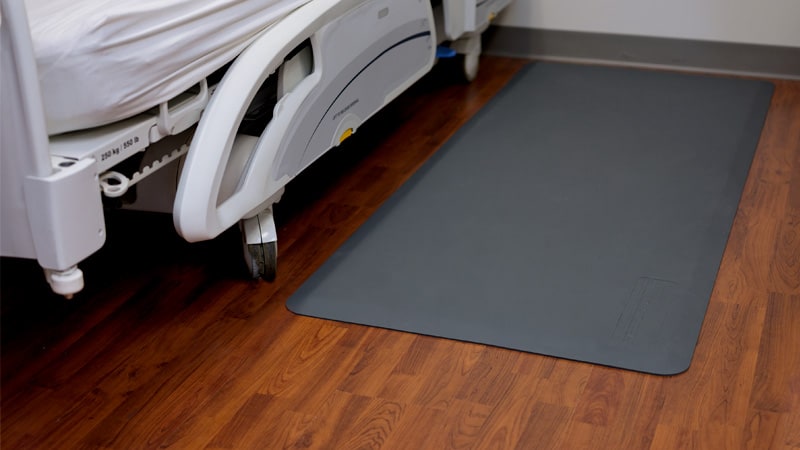
The Performance Mat is a bedside floor mat, purpose-built for both patient safety and staff efficiency. It features beveled edges on all four sides to minimize trip hazards and prevent curling, an advanced absorptive material that cushions falls without unnecessary thickness, and a stitch-free surface for added safety and durability.
By staying in place at the bedside, the Performance Mat eliminates storage problems and reduces extra work for nurses. The only residual trip concern is for patients with shuffling gaits, drop foot, lower extremity peripheral neuropathy that impairs sensation and motor function, though these individuals typically require assisted ambulation.
Floor Mat Resource List. Also located on the National Center for Patient Safety’s National Falls Toolkit website is a resource list of floor mats, available here. Most of these floor mats have beveled edges. You will learn about each product’s properties such as slip resistance, width and length dimensions, along with cost information from 2014. You will see pictures of the floor mats and other product information about thickness. Floor mats with glow-in-the-dark strips around the mat’s edges are available. The strips increase visibility of the bedside floor mat for staff and patients at night, which also may decrease the trip hazard.
These floor mat resources are available at your finger-tips, all designed to help you, your staff, your organization by providing the evidence, selection criteria, and strategies for implementation.
The Egg Drop Video. The Egg Drop video has been very effective in convincing nursing staff about the protective properties of floor mats. When a raw egg is dropped onto the floor mat, it does not break. Here is the website for this video: https://www.youtube.com/watch?v=cATSmo1QS4g
Help your nursing staff appreciate the amount of trauma a floor mat can absorb and reduce the trauma experienced by a patient upon floor impact.
Engage Your Nursing Staff. Working with many nurses and falls committees across this great country, I have suggested strategies to engage nursing staff in their fall injury prevention programs, as leaders in protecting patients from fall-related injuries. One such strategy is for the hospital Falls Committee to conduct a floor mat selection fair. Working with the nursing staff, review the listing of floor mats on the resource guide; select 3-4 floor mats from the list; contact the vendor for a sample; and have a floor mat fair where the nursing staff can see them, walk on them, move them, and select one.
For those of you already using floor mats but experiencing issues with reliable use, I suggest conducting floor mat rounds on your unit. During my rounds with nurses, we reviewed patients on the units who had a floor mat included in the care plan. Often, the floor mat was on the floor but needed placement adjustment — such as relocating the mat to protect the head and the torso, not the feet. Sometimes we found patients that should have a floor mat, but it was not present. We then went to a storage or supply area to find one. We joyfully placed the floor mat together at the patient’s bedside. Do inspect your floor mats. If the beveled edges are curling or cracking, make sure they are replaced. All efforts to protect patients from injury are a team effort.
I hope this information is helpful to you. I have so much confidence that you will be successful in integrating floor mats into your fall injury prevention program. And if you are using them already, to expand your use and increase floor mat use to protect your patients from experiencing a serious fall-related injury while in your care. You know some patients are going to get up from bed without you. If they do and start to fall, I know you would rather a patient fall onto a floor mat and protect them from injury. Creating a safe environment to protect from injury is our responsibility and an essential component for fall injury prevention programs.
Please contact me if I can be of assistance to you.
Thank you,
Pat
Patricia A. Quigley, PhD, APRN, CRRN, FAAN, FAANP, FARN
Nurse Consultant
[email protected]
090325
References
Boushon, B., Nielsen, G., Quigley, P., Rutherford, P., Taylor, J., Shannon, D., & Rita, S. (2012). How-to guide: Reducing patient injuries from falls. Cambridge, MA: Institute for Healthcare Improvement.
Bowers, B., Lloyd, J., Lee, W., Powell-Cope, G., Baptiste, A. (2008). Biomechanical evaluation of injury severity associated with patient falls from bed. Rehabilitation Nursing, 33(6):253-259.
Ganz, D.A., Huang, C., Saliba, D., Shier, V., Berlowitz, D., Lukas, C.V., .. . Neumann, (2013). Preventing falls in hospitals: A toolkit for improving quality of care. Rockville, MD: Agency for Healthcare Research and Quality. AHRQ Publication No. 13-0015-EF.
Gustavsson, J., Bonander, C., Anderson, R., & Nilson, F. (2015). Investigating the fall-injury reducing effect of impact absorbing flooring among female nursing home residents: initial results. Injury Prevention 21(5), 320-4.
National Center for Patient Safety (NCPS). (2014). Falls Toolkit. Floor Mat Resource and Implementation Guide. Washington, DC: Author. Available: https://www.patientsafety.va.gov/professionals/onthejob/falls.asp
Neily, J., Quigley, P., & Essen, K. (2015). Implementation Guide for Fall Injury Reduction: VA National Center for Patient Safety. Reducing Preventable Falls and Fall-related Injuries. Available: here
Oliver, D., Healey, F., Haines, T. (2010) Preventing falls and fall-related injuries in hospitals. Clinics in Geriatric Medicine, 26:645-692
Pearson, K.B., & Coburn, A.F. (2011, January). Evidence-based fall prevention in critical access hospitals. Policy Brief #24. The Flex Monitoring Program. ResearchGate. Available: https://www.researchgate.net/publication/261097465_Evidence-based_falls_prevention_in_Critical_Access_Hospitals
Quigley, P. (2015). Evidence levels: Applied to select fall and fall injury prevention practices. Feature Article. Rehabilitation Nursing, 41(1) 5-15.

Dr. Patricia Quigley is a Nurse Consultant, Nurse Scientist, Former Associate Director and VISN 8 Patient Safety Center of Inquiry. She is both a Clinical Nurse Specialist and a Nurse Practitioner in Rehabilitation, and her contributions to patient safety, nursing and rehabilitation are evident at a national level, with emphasis on clinical practice innovations designed to promote elders’ independence and safety. She is nationally known for her program of research in patient safety, particularly in fall prevention. The falls program research agenda continues to drive research efforts across health services and rehabilitation researchers.